Tracking Earthquakes and Volcanoes Using Google Earth
Part 1: Tracking Earthquakes
An earthquake is a term used in science to describe the vibrations of the earth due to volcanic or tectonic movement. Many earthquakes originate from these tectonic regions. Listed below are earthquakes that occurred along the divergent, transform, oceanic-oceanic, oceanic-continent, and continental-continental boundaries.
1. This earthquake was a 6.2 in magnitude, having a focus depth of 9.9 km (6.2 miles), occurred in the Drake Passage region south of Argentina, South America, on April 14, 2012 at 6:56 AM local time. (April 14, 2012 3:56 AM MST) The Drake Passage Earthquake is an Oceanic-Continental convergence due to the relative location to the South America and Antarctica continents which creates a subduction zone where the denser layer is pulled into the layer below. This also is where “slab pull” occurs, which causes shallow focus earthquakes, such as the one noted here.

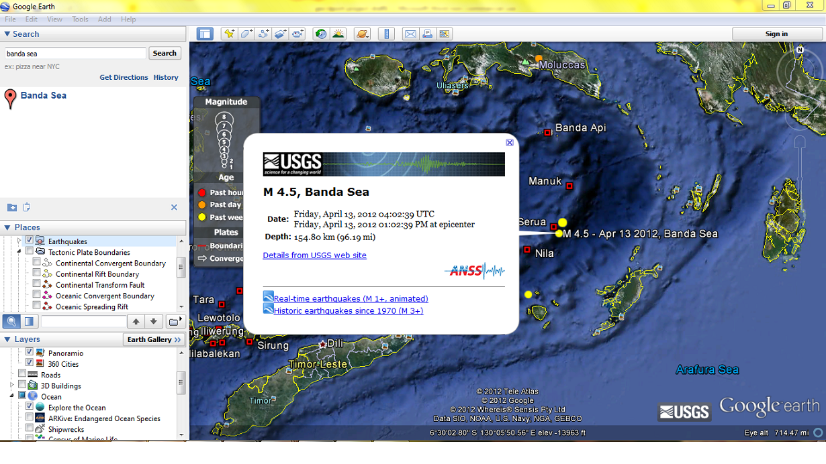
2. An earthquake with a 4.5 magnitude, with a focus depth of 154.8 km (96.2 miles), located in the Banda Sea, occurred April 13, 2012 at 1:02 AM local time (April 12, 9:02 PM MST). The earthquake that transpired in the Banda Sea occurred along a convergent boundary, in this case, an Oceanic-oceanic boundary. This type of boundary is usually located between two oceanic plates, and uses subduction in its process, but, unlike the oceanic-continental boundary, deep focus earthquakes often occur, such as the one noted below. Volcanic activity is initiated in these zones, and with time volcanic islands are formed, such as those that are located in the Banda Sea.
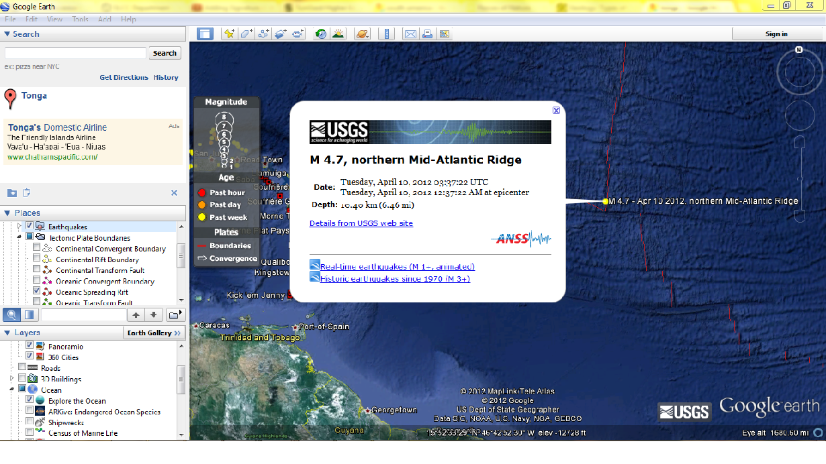
3. An earthquake with a 4.7 magnitude, with a focus depth of 10.4 km (6.5 miles) occurred at the Northern Mid-Atlantic Ridge on April 10, 2012 at 12:37 AM local time (April 09, 2012 at 08:37 PM MST). The northern Mid-Atlantic earthquake occurred along a Divergent Boundary, where molten flows upward through the opening between the plates, and where volcanic vents spill out basaltic lava flow; these are often called mid-oceanic ridges, and in this case is located along what is called the mid Atlantic ridge. These divergent boundaries often cause shallow earthquake focuses, and this one recorded below is no different.
4. A 5.9 magnitude earthquake with a focus depth of 10.2 km (6.3 miles) occurred off the Coast of Oregon on April 11, 2012 at 1:41 PM local time (3:41 PM MST). This earthquake occurred on a transform fault, where two plates slip past each other in a vertical manner. These types of faults cause shallow focus earthquakes, such as the one noted here. This particular transform fault is located just outside an oceanic-continental subduction zone but is itself a divergent boundary as its movements are more consistent with a transform fault than a subduction zone.

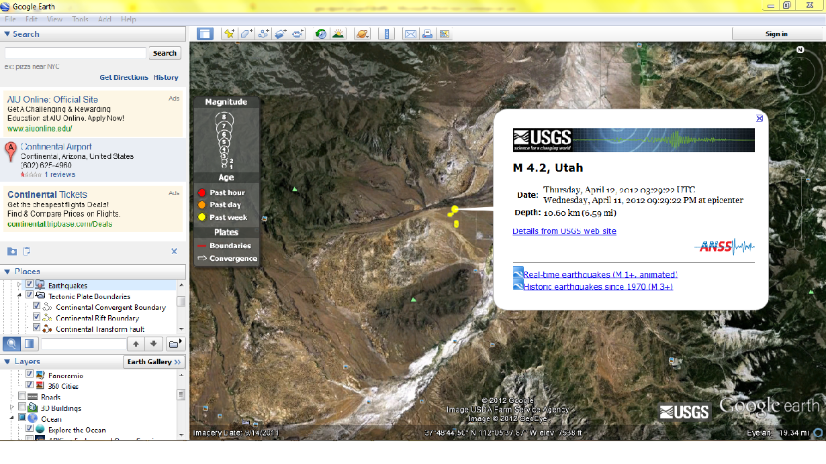
5. A 4.2 magnitude earthquake with a focus depth of 10.6 km (6.6 miles) occurred on April 11, 2012 at 9:29 PM local time (also MST). This earthquake occurred in an area where no oceanic plates are located, but rather occurred where two continental plates are located, and is therefore on a continental to continental boundary. Continental-continental boundaries occur because there is no oceanic plate and are too buoyant for subduction to occur; without subduction occurring, these plates collide together. These types of plate movements create mountain ranges, such as those scattered throughout Utah, including this area where the earthquake occurred.
Part 2: Tracking Volcanoes
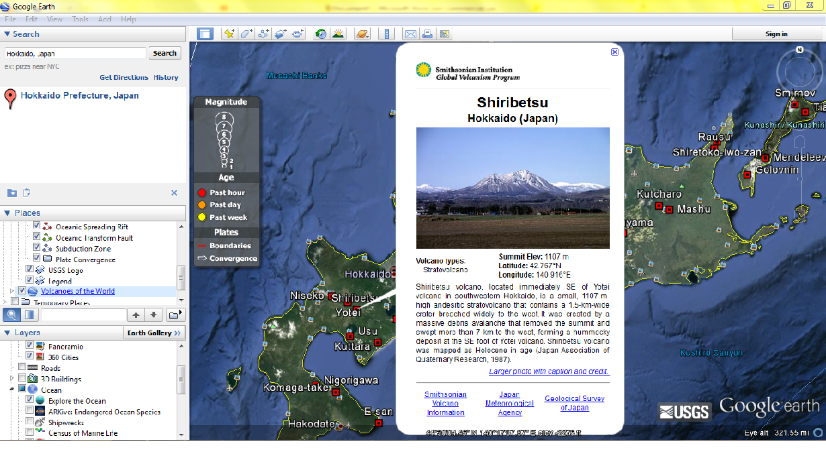
1. Shiribetsu, Hokkaido, Japan. This is an example of a Composite or Strato-Volcano. Shiribetsu is near an oceanic-continental tectonic boundary. Through the subduction process, the Kuril trenches formed and, as a result the chain of volcanoes located in Hokkaido (including Shiribetsu) formed.
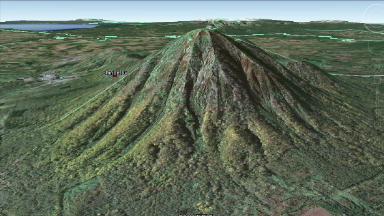
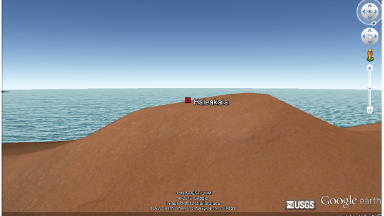
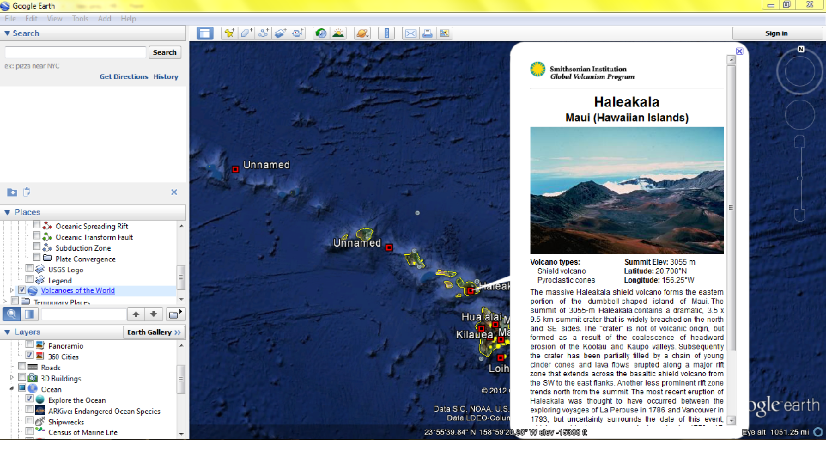
2. Haleakala Volcanic Range in Maui, Hawaiian Islands USA. This is an example of a shield volcano. Haleakala is located on a divergent boundary. This volcano is located within the Pacific rift, part of what is called the "ring of fire". It was created from "Hot Spots" through which high pressure and hot magma erupted and over time created the island chain.
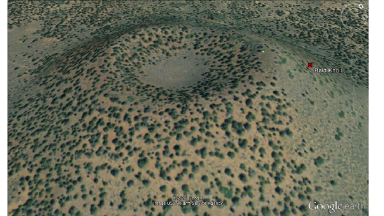
3. Bald Knoll, Utah, USA. This volcano is of the cinder cone type. This volcano sits within a continental-continental tectonic boundary, which also helped form the mountains of the region. Notably, Bald Knoll is the youngest basaltic cinder cone volcano in the region.

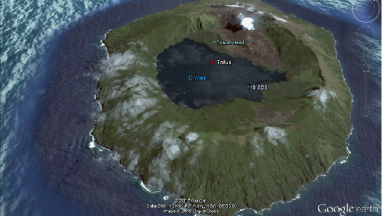
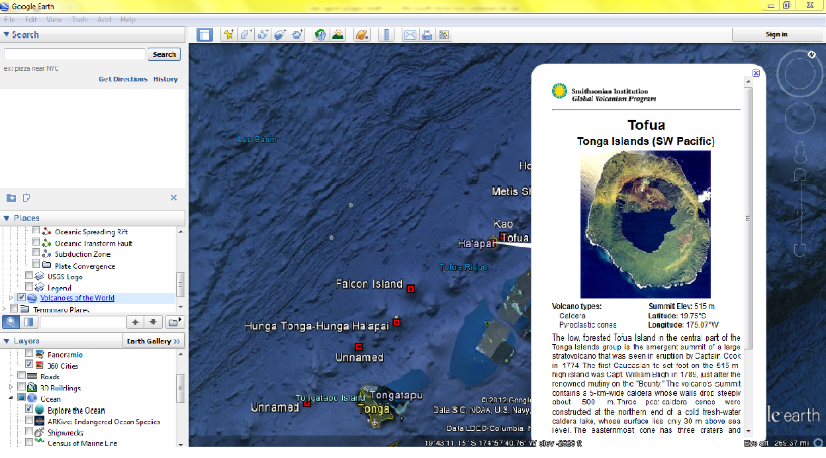
4. Tofua, Tonga Islands in the Southwest Pacific. This is an example of the caldera volcano. This volcano is lies near an oceanic-oceanic converenge boundary. This volcano was likely a strato-volcano, but at some point in its history a massive eruption caused the magma chamber to empty and resulted in the collapse of the structure.